
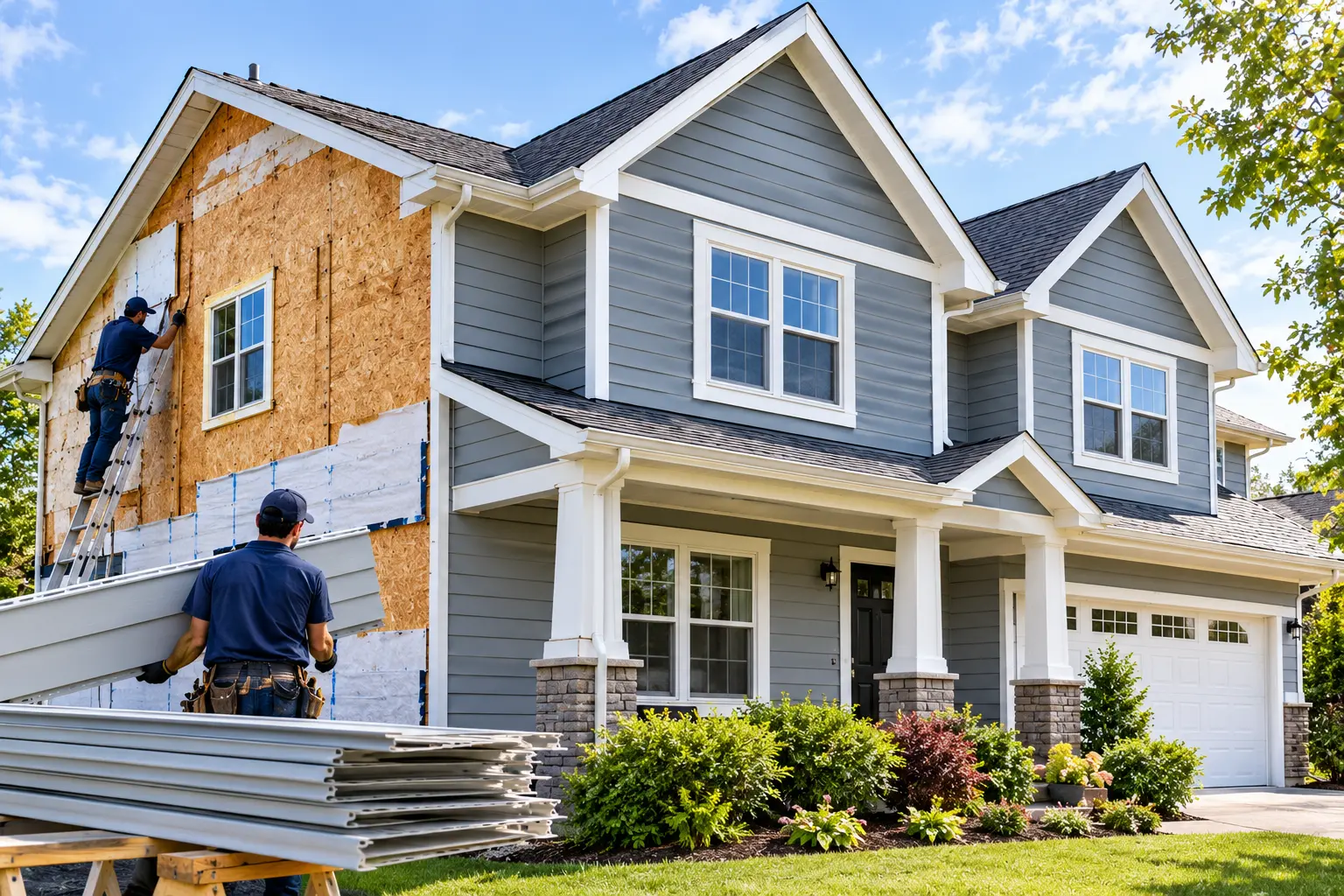
If you’ve read our post on the warning signs — warping, cracks, that rippling look — and you’ve decided it’s time, here’s what the actual process looks like, because it’s honestly less complicated than people assume going in.
First conversation is mostly about material
Vinyl’s the most common thing we install, mostly because it’s durable, doesn’t need painting, and holds up well through Ohio winters without a ton of maintenance. But we’ve also got people who want fiber cement for a different look or better fire resistance, and that’s a heavier, more involved install but it’s an option depending on what you’re going for and what you want to spend. This is the conversation where we also talk color, since that’s obviously permanent once it’s up there and not something you want to second-guess a year later.
Once the old siding comes off, this is actually the part that matters most and nobody thinks about going in
Same as with roofs — what’s underneath tells the real story. If that’s the case, it gets replaced before anything new goes up, because putting new siding over bad wood underneath just means you’re covering up a problem instead of fixing it, and it’ll show up again down the road, probably in a worse way.
This is also when we check and upgrade the house wrap if it needs it — that’s the moisture barrier layer that sits between your sheathing and the siding, and it’s honestly doing a lot of the real work in keeping water out, more than people realize since you never see it once the siding’s up.
Then the actual siding installation.
This part goes faster than the demo and prep stage usually. Starter strips go in at the bottom first to get everything level, then the panels go up working upward, with proper spacing left at seams since siding needs a little room to expand and contract with temperature changes — installed too tight and it can buckle later, especially with how much our temperature swings around here through the year. Trim work around windows, doors, and corners is honestly where you can tell a rushed job from a careful one, so we spend real time on those details instead of rushing to just get panels up.
Timeline-wise, a typical house is usually a few days, sometimes up to a week if there’s sheathing repair needed underneath or if it’s a bigger or more complicated house with a lot of corners and trim work. Weather plays a role too, same as with roofing — you’re not installing in the middle of a downpour.
On cost, since everyone wants a number and nobody wants to just guess — it depends heavily on square footage, material choice (vinyl vs fiber cement is a real cost difference), and whether there’s sheathing repair involved once we get the old stuff off. We do offer financing if the upfront number is the thing holding you back, worth checking the payment calculator on the site for a starting point.
One thing worth mentioning honestly
sometimes people come to us wanting full replacement when really a section repair would’ve handled it, especially if the damage is localized to one wall or area from something like storm impact. We’ll tell you straight if that’s the case rather than pushing the bigger job — no reason to replace the whole house’s siding if one wall took the hit.
If you’re ready to move forward, or just want an honest look at whether you need full replacement versus a repair, give us a call at (614) 918-0018.